

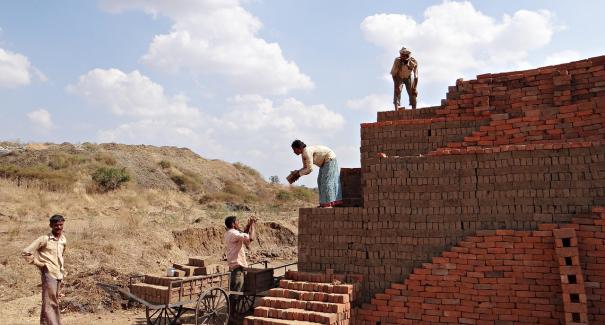
A few years ago, outside the Transport Commissioner’s office in Bandra, thousands of Ola and Uber drivers staged a protest.
Columns, et al
Columns by date

By Vappala Balachandran |
Various theories have been advanced to explain the reasons for Donald Trump’s order to abduct Venezuelan President Nicolas Maduro and attack the resource-rich Latin…

By GN Bajpai |
We head into the New Year with India continuing to be the fastest growing large economy in a world marked by challenges.

By Jagdish Rattanani |
The debate on the ever-alive topic ‘Does God exist?’ between the well-known poet and lyricist Javed Akhtar, an atheist, and the graduate of Islamic studies Mufti…

By Ajit Ranade |
The passage of the Viksit Bharat Guarantee for Rozgar and Ajeevika Mission (Gramin) Bill, 2025 called the VB-G RAM G Bill, marks a decisive break from one of India’s…

By Jagdish Rattanani |
Conventional thinking from mainstream economists travelling down to the average citizen has it that GDP growth is desirable and good – the higher the better.

By Ajit Ranade |
When IndiGo cancelled thousands of flights this December—stranding lakhs of passengers, destroying travel plans, and exposing India’s vulnerability to a quasi-…

By Himadri Bhattacharya |
The MPC’s decision to cut the policy rate by 25 basis points to 5.25 per cent, on the conclusion of its last bi-monthly meeting of 2025 on December 5 was contrary to…

By Jagdish Rattanani |
It has long been argued that India’s labour laws hold back business, particularly the manufacturing sector, from roaring into action and joining the India growth…

By Asuri Vasudevan |
The announced implementation of the four Labour Codes by the Government of India last week is a bold and timely move, given the political opposition to the Indian…

By Ajit Ranade |
India’s major economic reforms were spurred by a foreign exchange crisis. It was the summer of 1991 when foreign exchange reserves went to nearly zero.

By Ajit Ranade |
India’s Right to Information (RTI) Act came into force on 12 October 2005. It is one the strongest transparency laws in the world.

By Asuri Vasudevan |
The question is whether digital assets and stock markets gain at the expense of bank deposits or deposits with corporates or non-bank financial intermediaries.